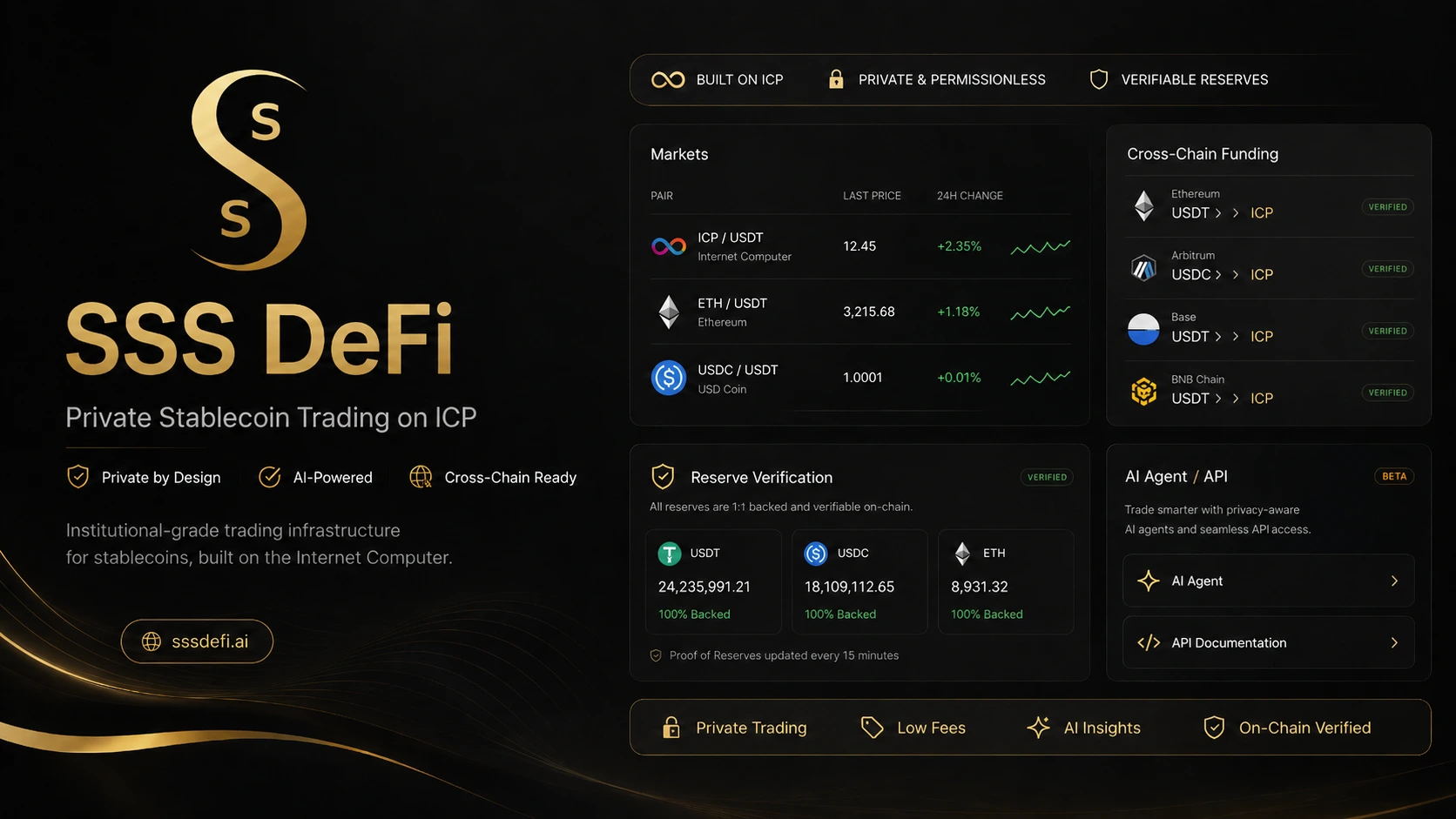
SSS Public Beta: A Major Infrastructure Upgrade Toward CEX-Grade On-Chain Trading
Ethereum funding, canonical stablecoin markets, fast on-chain execution, verifiable reserves, Wallet Swap Flow v2, and Agent Kit v1.2 are now part of the SSS public beta stack.
- SSS is moving from an ICP-native DeFi prototype toward fast private stablecoin trading infrastructure on ICP.
- Ethereum funding routes, canonical USDT/USDC balances, and CEX-style public markets are now part of the public beta direction.
- Wallet Swap Flow v2 and Agent Kit v1.2 make SSS easier for wallets, bots, and AI agents to integrate.
Over the past several weeks, SSS DeFi has gone through a major internal architecture upgrade.
This upgrade is not just about adding a few features or improving a few pages.
More importantly, SSS is moving beyond an ICP-native DeFi prototype and evolving into a CEX-grade on-chain trading system built on ICP.
Our direction is becoming clearer:
Private Stablecoin Trading on ICP
CEX Experience · DEX Trust
SSS aims to give users a smoother and faster exchange-like trading experience while keeping the trust model of on-chain execution, verifiable settlement, and transparent system records. In optimized paths, SSS can complete a trade in as fast as about 0.15 seconds, with on-chain finality around 1.5 seconds.
You can try the public beta here: Launch SSS App.
1. From DeFi Prototype to On-Chain Trading Infrastructure
The early version of SSS proved that a fully on-chain trading experience on ICP is possible.
But the latest public beta upgrade moves SSS toward something larger: a trading infrastructure layer.
SSS is no longer only a swap interface or a liquidity pool system.
It is becoming a unified trading stack that includes:
- stablecoin markets;
- unified internal balances;
- cross-chain funding routes;
- low-latency on-chain trade execution;
- receipts and activity records;
- reserve and route safety checks;
- wallet integration APIs;
- and AI-agent-ready trading interfaces.
In short, SSS is building the account, funding, trading, verification, and integration layer needed for a faster, more exchange-grade on-chain trading system.
2. Ethereum Mainnet Funding Routes
One of the most important upgrades is the integration of Ethereum Mainnet funding routes.
SSS now supports infrastructure for:
- ETH funding;
- USDT funding;
- USDC funding;
- Ethereum wallet-based funding flows;
- and address-based funding routes.
This matters because users should not be limited to assets that already sit inside the ICP ecosystem.
Many users already hold ETH, USDT, or USDC on Ethereum. SSS is building a path for those users to bring assets into SSS and trade from unified internal balances.
In public beta, this is still an evolving system. But it is a major step toward making SSS usable by a wider group of stablecoin and Ethereum users.

3. Canonical USDT and USDC Inside SSS
A major part of this upgrade is the move toward a cleaner canonical asset model.
Inside SSS, USDT is USDT and USDC is USDC.
Underlying funding routes may differ. Assets may enter through ICP routes, Ethereum routes, or other supported rails. But once inside SSS, the user-facing trading balance should remain simple and understandable.
The goal is simple:
Funding routes may differ.
The trading balance stays unified.
This is important because most users do not want to think in terms of every underlying rail, wrapper, or technical asset format.
They want to know:
- Do I have USDT?
- Do I have USDC?
- Can I trade?
- Can I deposit and withdraw?
- Can I verify what happened?
SSS is moving toward that cleaner account model.
4. CEX-Style Public Markets
SSS public beta is also moving toward more intuitive trading pairs.
The current public market focus includes:
- ICP / USDT;
- ICP / USDC;
- ETH / USDT;
- ETH / USDC;
- USDC / USDT.
These markets are easier for traders, wallets, bots, and agents to understand immediately.
ICP/USDT is the most direct ICP dollar market.
ETH/USDT and ETH/USDC are core blue-chip markets.
USDC/USDT is important for stablecoin conversion and balance rebalancing.
For liquidity providers, these markets are also the current focus of SSS public beta liquidity growth.
You can explore markets here: SSS Trading App.

5. Stronger Reserve, Solvency, and Route Safety System
A trading system needs more than swaps.
It needs to understand:
- what assets the system holds;
- what liabilities users own;
- which funding routes are liquid;
- which withdrawal paths are healthy;
- whether reserves can be checked and reconciled.
In the latest internal architecture, SSS separates several important concepts:
- token-level solvency;
- route-level execution liquidity;
- reserve reconciliation;
- keeper-based verification;
- public release safety gates.
The core solvency principle is:
Total assets should be greater than or equal to total liabilities.
At the same time, total solvency and route-level liquidity are not the same thing.
A system may be solvent at the token level while a specific withdrawal route temporarily needs more liquidity. That is why SSS separates total reserves from route execution liquidity.
This distinction is important for building a safer and more transparent exchange-grade system.
6. Wallet Swap Flow v2
SSS is also improving the integration model for wallets and ecosystem applications.
Wallet Swap Flow v2 is designed to help external wallets and integration partners use SSS more easily as a trading backend.
The goal is to avoid forcing every wallet to rebuild the same funding, routing, swap, and final-state verification logic from scratch.
Wallet Swap Flow v2 includes:
- pool discovery;
- route-funded swap flow;
- funding-source abstraction;
- better final-state verification;
- clearer integration boundaries for wallets.
This is important because SSS should not only serve its own frontend.
It should also become trading infrastructure that wallets, bots, and ICP ecosystem applications can call.

7. Agent Kit v1.2: AI-Ready Trading Interfaces
One of the newest parts of the upgrade is SSS Agent Kit.
This is an important direction, but the boundary should be clear.
SSS is not launching a hosted AI trading bot.
SSS does not run the AI model.
SSS does not store user LLM keys.
SSS does not custody user private keys.
SSS does not allow agent withdrawals in Agent Kit v1.2.
Instead, SSS provides deterministic on-chain trading interfaces that external agents can call.
The simplest way to describe it is:
AI plans. SSS executes on-chain.
Agent Kit v1.2 currently supports:
- market context;
- portfolio read;
- swap preview;
- limit order draft preview;
- self-account swap submit;
- action status by
client_tx_id; - recent action history;
- OpenClaw-style quickstart and smoke test examples.
You can read the Agent Kit docs here: SSS Agent Kit.
Developers can also inspect the Agent Manifest and the OpenClaw Quickstart.
The recommended account model is simple:
- create a dedicated Agent Principal;
- deposit only the intended trading balance into that Principal’s SSS account;
- let the agent read, preview, submit self-account swaps, and track status;
- do not expose the user’s main wallet identity;
- do not enable withdrawals for agents.
This gives developers a low-cost and lower-risk way to experiment with AI agents, bots, and automation on SSS.

8. Internal Ledger and Core Architecture Optimization
Behind the user interface, SSS has also gone through major core and frontend architecture optimization.
The focus has been:
- lower latency;
- cleaner state management;
- more robust internal balances;
- better separation between trading, funding, reserves, and account records;
- and a stronger base for future exchange-grade features.
In the latest optimized flow, the product goal is not only to be verifiable, but also fast enough for real trading: transactions can complete in as fast as about 0.15 seconds, with chain finality around 1.5 seconds.
This matters because SSS is not only building a swap page.
If SSS is to support more advanced trading tools over time, the internal ledger, execution logic, accounting boundaries, and verification model must continue to improve.
This upgrade is part of that longer path.
9. Public Beta Is Also an Ecosystem Formation Stage
SSS is still in public beta.
That means the system will continue to improve. It also means this is a meaningful time for early users, liquidity providers, wallets, bots, and builders to participate.
There are several ways to get involved:
For traders
Try the public markets on SSS App, including ICP, ETH, USDT, and USDC pairs.
For liquidity providers
Provide liquidity to core public beta markets such as ICP/USDT, ETH/USDT, and USDC/USDT.
For wallets and ecosystem apps
Start from Wallet Swap Flow v2 and explore how SSS can serve as a trading backend.
For bots and AI agent builders
Start from Agent Kit, Agent Manifest, and the OpenClaw Quickstart.
For early contributors
Explore Growth Room, which is being prepared as a way to recognize early public beta contributions across trading, liquidity, testing, growth, trust, referral, and builder activity.
Growth Room is not only for developers, traders, or liquidity providers. SSS can also evaluate XP for people who help the project grow in public: active Telegram and X/Twitter community members, article and video creators, tutorial makers, product feedback contributors, testers, translators, ecosystem connectors, and anyone whose work helps more users, LPs, wallets, bots, or agent builders discover and understand SSS.
XP is intended to reflect real contribution under the public beta program rules and eligibility. It is not a guaranteed payment, but a way to make early participation more visible and more accountable.

10. What Comes Next
The next stage of SSS public beta will focus on several areas:
- improving the homepage, docs, and product entry points;
- strengthening liquidity in core public markets;
- improving funding, withdrawal, reserve, and route safety flows;
- helping wallets and apps integrate through Wallet Swap Flow v2;
- helping bots and AI agents integrate through Agent Kit;
- improving Growth Room and early contribution tracking;
- and continuing to simplify the product experience for real users.
SSS is still early, but the direction is now much clearer.
Conclusion
This public beta upgrade marks an important transition for SSS.
SSS is moving from an ICP-native DeFi prototype toward a private stablecoin trading infrastructure layer on ICP.
It is not just building swaps.
It is building:
- account-based trading;
- canonical stablecoin balances;
- cross-chain funding;
- verifiable reserves and receipts;
- wallet integration APIs;
- and AI-agent-ready execution interfaces.
The long-term direction is clear:
Private Stablecoin Trading on ICP
CEX Experience · DEX Trust
SSS aims to give users a smoother and faster exchange-like experience while preserving the trust model of on-chain settlement.
If you are a trader, liquidity provider, wallet developer, bot builder, or AI agent builder, this is a good time to explore the SSS public beta.
Start here: